


The Government on 13th June 2019(Thursday) announced reducing the rate of ESI contribution from 6.5% to 4%.
The Government of India has taken a decision to reduce the rate of contribution under the ESI Act from 6.5% to 4%
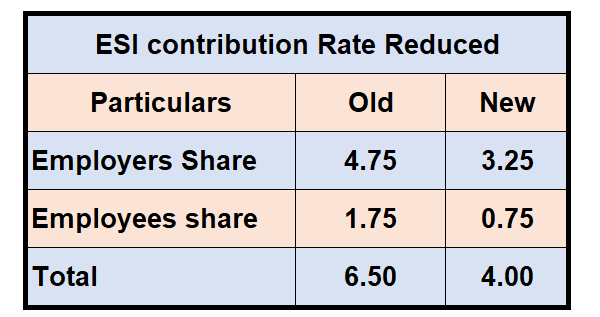
- Employers’ contribution being reduced from 4.75% to 3.25%
- Employees’ contribution being reduced from 1.75% to 0.75%
As per the press release issued by the Ministry of Labour and Employment reduced rates will be effective from 1st July 2019.

Download Reduced ESIC Contribution Rate Gazette Notification
“The reduced rate of contribution will bring about a substantial relief to workers and it will facilitate further enrollment of workers under the ESI scheme and bring more and more members of the workforce into the formal sector”
The healthcare benefits under the ESI Scheme will remain the same, but employees would now have to contribute just 0.75% of their salary(Basic plus Allowances), instead of the existing 1.75%, while the employers’ contribution will come down from 4.75% to 3.25%, according to the ministry of labor and employment.
It would benefit 36 million insured persons and 1.3 million organizations.
ESIC Contribution Rates Old & New
Old ESIC Contribution Rates
- Employer Contribution 4.75%
- Employee Contribution 1.75%
- Total Contribution 6.5%
New ESIC Contribution Rates
- Employer Contribution 3.25%
- Employee Contribution 0.75%
- Total Contribution 4%
Use of new ESI Contribution Rates
If the ESIC contribution rates decrease then the in-hand salary of employees will increase and for employers also it reduces some burden. The reduced ESIC Contribution rates motivate employers to bring more employees in Employee State Insurance Scheme.
Affect on ESIC Benefits
No, there is no effect on ESIC benefits. All the benefits for ESIC members will remain the same and the reduction in ESIC contribution rates is only to bring more employees in the ESIC scheme.
Eligibility for ESI Scheme
Employees whose monthly gross salary is Rs.21000 or below Rs.21000 are eligible for ESI Scheme.
ESIC Contribution Calculation as per Reduced Contribution Rates
For example, if an employee’s monthly gross salary is Rs.17000 then ESIC will be calculated in the following manner:
Employee Contribution 0.75% = 17000 x 0.75% = Rs.127.5
Employer Contribution 3.25% = 17000 x 3.25% = Rs.552.5
Total Contribution 4% = Rs. 680
How ESIC Collects contributions
Every employer needs to make ESIC Contribution payments within 15 days after the following month. If employers aren’t able to pay ESIC contribution on or before ESIC due date then they need to pay penalties.
- Employers need to login to their ESIC employer part at the esic.in website.
- After login, they need to enter the ESIC Contribution of their employees by clicking on pay monthly contributions or they can also upload a bulk excel sheet of all the employees’ contributions.
- Once they upload the excel sheet then a challan will generate.
- Now Employers need to make the payment of that ESIC Challan.
Employees who have contributed to ESIC will be eligible for ESIC cash benefits in ESIC beneficial period, here is the table of ESIC contribution period and cash benefit period.
| Contribution Period | Cash Benefit Period |
| 1 April to 30 September | 1 January to 30 June |
| 1 October to 31 March | 1 July to 31 September |
—————————————————————————————————————————————————————————————————————————————————————-
ESI Notification -The Gazette Notification dated 15th February 2019 proposes a reduction in both the employees’ and employers’ ESI contribution towards the scheme.
Ministry of Labour and Employment, Government of India has issued Draft Rules proposing to reduce rates of ESI contribution.
Currently, the employee’s ESI contribution rate is 1.75% of the wages and employer’s is 4.75% of the wages paid in respect of the employees in every wage period.
Now, the Central Government is planning to lower the ESI contribution rate of 1%( for employee) and 4% (for an employer).
Still, the effective date of new ESI contribution rates has not announced.
Any objection or suggestion, which may receive from any person in respect of the said draft rules within 30 days, will be considered by the Central Government.
Proposed Revised Rates of ESIC Contribution(effective date yet to be notified)
In line with the proposed amendment/reduction in ESI contribution notified by the Government, the revised rates of contribution by Employer and Employees are as under:
Notification

All about ESI
ESI
Employees’ State Insurance is a self-financing social security and health insurance Scheme for Indian workers.
Eligibility for ESI
Employees who are drawing salary/wages less than or equal to Rs.21000 per month are eligible for the ESI Scheme.
Wages means all remuneration paid or payable in cash to an employee.
Wages for ESI Contribution
- Basic Pay
- Dearness Allowance
- House Rent Allowance
- City Compensatory Allowance
- Production Incentive
- Night Shift Allowance
- Meal/Food Allowance
ESI Contribution Period
- 1st April to 30th September
- 1st October to 31st March
ESI Benefit Period
- 1st January to 30th June
- 1st July to 31st December
The benefit period starts three months after the closure of a contribution period.
ESI Benefits to Employee
ESI social security scheme includes:
- Medical Benefit – for self & family
- Sickness Benefit – for self
- Maternity Benefit – for self
- Disablement Benefit- for self
- Dependent’s Benefit – for dependants
For Employer/Company
Levy of Interest and Damages
The employer is liable to pay simple interest at the rate of 15% per annum in respect of each day of delay in the payment of contributions.
Period of delay in payment of contribution Rate of Damages on the amount due
Up to less than 2 months 5%
2 months and above but less than 4 months 10%
4 months and above but less than 6 months 15%
6 months and above 25%
HRAPP is an HRMS solution that offers easy employee management from hiring to retiring. We help businesses and organizations simplify the recruitment process and make payroll processes easy. Our proactive remote employee monitoring software helps businesses monitor remote employees by efficiently tracking the remote workforce’s productivity.
To follow the related link:
To follow our previous blog kindly find the link below:


